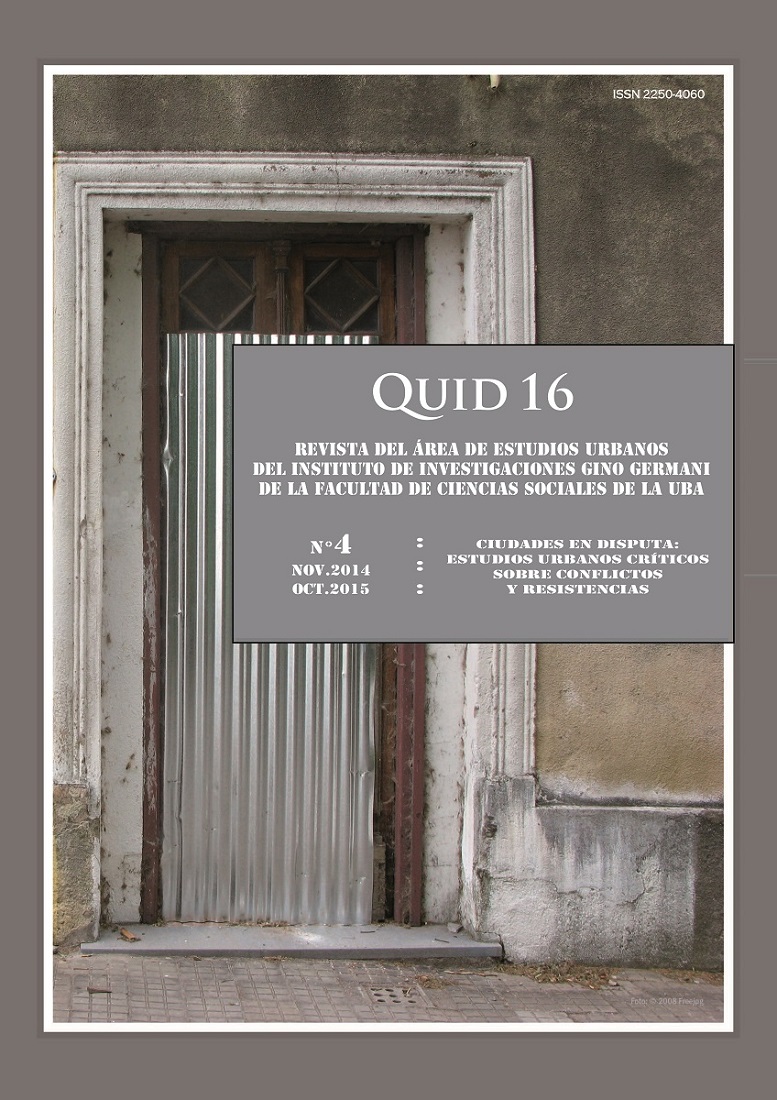
Nº 4 (Nov.2014-Oct.2015): Conflicting cities: urban studies about conflicts and resistance.
Along an abundance of literature about urban neoliberalism and its cities as a material disposition of the policies rooted in mainstream ideological conformism, these recent years have seen the awakening of important debates over social urban movements, citizenship and resistance to those policies. The diverse claims, ranging from the outrage against austerity policies that plagued Southern Europe in 2011, to the fight over habitation spaces and the squatting of buildings, as well as the multiple resistance movements of those excluded in Latin America, have a common agenda in discussing a new way of exposing the negative consequences of urban neoliberalism, while proposing alternatives to the hegemonic urban policies. From the perspective of urban studies, we can attest to the existence of a new debate cycle that prioritizes the conflicting conditions in the modern city. The QUID 16 dossier will articulate itself over that relationship, emphasizing on cities in dispute, with the objective of promoting critical urban studies about conflicts and resistances.
In the context of the present dossier, it is of interest to provide reflection not only about the reconfiguration of individuals and groups as active subjects of policy formation, but also about those minimal resistance cases, less socially visible, which are also a part of our contradictory urban existence. Among the diverse forms which the resistance processes assume in our cities, we find, in terms of Laclau, the consolidation of an equivalent logic between the demands of certain groups: the “waiting time” of maximally relegated habitats just looking to be “deserving” of certain policies, or the practical impugnation of the legitimate habitation practices related to the forceful occupation of spaces. In addition to this, we find an endless number of urban environmental or cultural practices of resistance, such as murals or urban community gardening in defense of public spaces. In the same way as urban policies are transferred and travel along different nations and cities, the criticism, the anti-gentrification movements and groups can also travel and learn from one another to fight in an active way. In this sense, it is interesting to research in which way the current protest movements develop networks that seek new citizenship spaces, thus creating alternative geographies. We so encourage the participation of those works that explore diverse conflicts, citizenship letters and resistance in our cities from theoretical and empirical standpoints.
Published:
2014-11-11