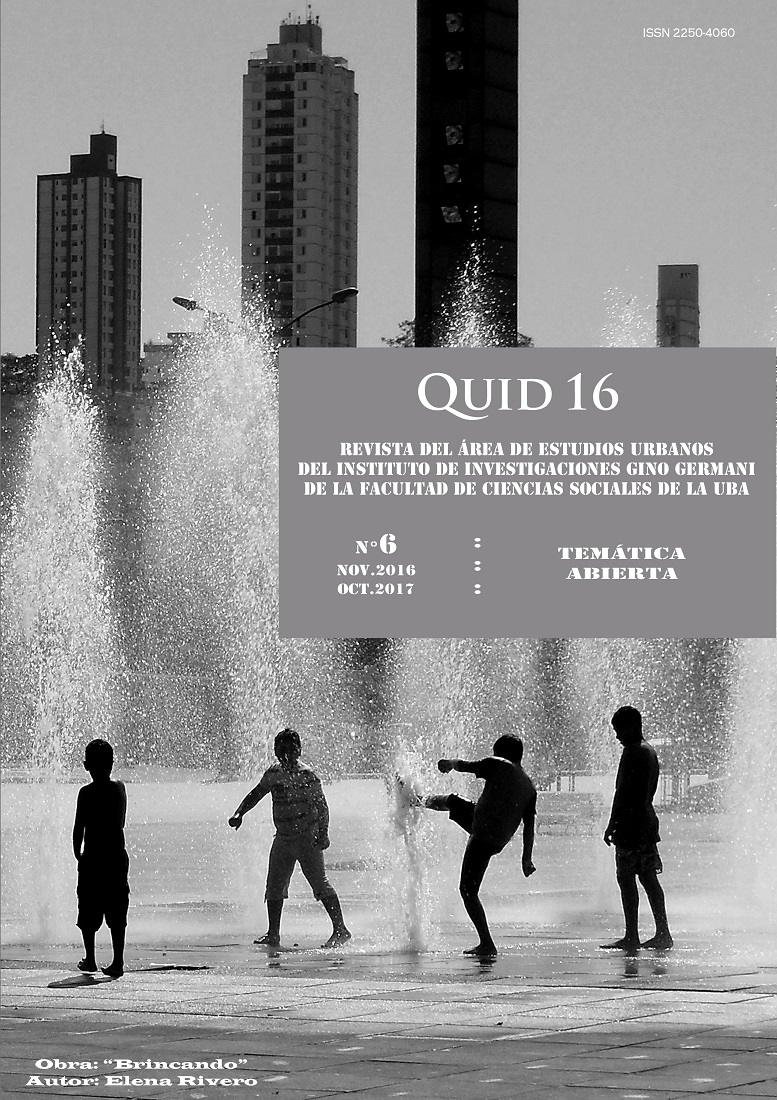
Nº 6 (Nov.2016-Oct.2017): Open subject
Editor Notes
For QUID 16, Urban Studies Area Magazine, 2016 was a year full of challenges, as a new editorial team has the responsibility to continue the legacy of sustaining the magazine as a highly recognized publication by the scientific community on both national and international level.
The magazine’s production is sustained between the members of an in house team of researchers, as the spirit of the Urban Studies Area of the Gino Germani Institute dictates. For this reason, the editorial team is composed by fellows and researchers of the Area, who are also backed up by the editorial council, the international scientific committee and the external editors and evaluators.
To face this new challenge, the growing editorial team of this magazine chose to call out for the submission of articles with no specific subject in mind, in order to get acquainted with the complex workings of the Magazine. However, between the huge quantity of received productions, the ones that stood out where those related to informal and precarious settlements, usually knowns as “villas de emergencia” or simply, “villas”, all from the most diverse approaches and disciplinary standpoints.
This recurrent thematic present in the submitted materials puts in evidence the need to approach and comprehend this phenomenon by the academic and scientific community. Such as it is, the process of production of social habitats in Latin American countries, and in particular, the extended proliferation of informal settlements spread throughout those territories as a way of habitation in great urban centers has made clear that in the last years, this has been the main form of urbanization in the countries of this region.
Among the main challenges of the current scientific research are the comprehension of how this urban and social phenomenon develops, explaining the multiple social, economic, political and cultural causes that influence this city creation processes, interpreting the network of actors that intervene, the role of the State and the Market, as well as many other vectors of analysis.
For this reason, we determined that, in spite of the open themed orientation of this number, we had to create a dossier with articles that approach this phenomenon and to consult with specialist as commentators.
Aside from this fact, the current number has the usual content of open themed articles, with authors that are referents in urban studies, the Urbanidades [Urbanities] section, with reviews that update the state and the art of our disciplines, and we also introduce the recent Novedades [News] section in which we seek to divulge the results of our post-graduate thesis investigations and/or our scientific research and extension activities.
We take this opportunity to appreciate the recognition that this Magazine has earned as a space for the divulgation and discussion of urban issues and we hope that QUID 16 continues to configure itself as an unavoidable space for urban studies.
Published:
2016-12-06